Question
Under what circumstances the conveyor (as shown in your Blog) is preferred for material handling requirements? Explain.
Answer
Conveyors are extremely useful when there is high throughput and large volumes are needed to be move rapidly and safely. They are very efficient in transporting a wide variety of materials of all sizes, shapes and weights thus making the use of conveyors preferred over other equipments. They also have safety features, which helps prevent accidents, making it safer then other equipments. The use of conveyors also means that less labor are needed and therefore reducing labor expenses. They can also be installed almost anywhere; overhead, in-floor or on-floor. Moreover, it is a flexible system as there is a variety of options to fit the requirements of the company, which include the hydraulic, mechanical and fully automated systems.
Sunday, January 13, 2008

Material Handling Systems

The purpose of this blog is to help you understand more about material handling equipments and we hope that you will find it helpful.
Handling systems enables efficient movement of goods, lifting goods in and out of storage, facilitates vehicle loading and unloading, reduces unecessary movements and maximizes the use of height for storage.

There are many different types of handling systems which can be seperated into 3 areas, Trucks, Conveyors and Cranes and they will be talk about more in detail in the other posts.
Radio Frequency Identification,
RFID, Short for radio frequency identification, is a dedicated short range communication (DSRC) technology. The term RFID is used to describe various technologies that use radio waves to automatically identify people or objects. RFID technology is similar to the barcode identification systems we see in retail stores everyday; however one big difference between RFID and bar code technology is that RFID does not rely on the line-of-sight reading that bar code scanning requires to work.
A Radio-Frequency IDentification system has three parts:
- A scanning antenna
- A transceiver with a decoder to interpret the data
- A transponder - the RFID tag - that has been programmed with information.
The scanning antenna puts out radio-frequency signals in a relatively short range. The RF radiation does two things:
It provides a means of communicating with the transponder (the RFID tag) AND
It provides the RFID tag with the energy to communicate (in the case of passive RFID tags)
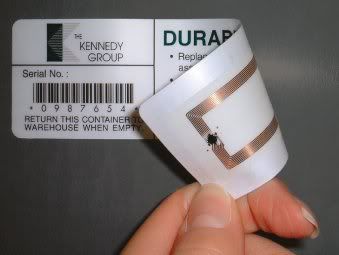
An example of a RFID tag
When an RFID tag passes through the field of the scanning antenna, it detects the activation signal from the antenna. That "wakes up" the RFID chip, and it transmits the information on its microchip to be picked up by the scanning antenna.
Common Uses of RFID
- RFID systems are being used in some hospitals to track a patient's location, and to provide real-time tracking of the location of doctors and nurses in the hospital. In addition, the system can be used to track the whereabouts of expensive and critical equipment, and even to control access to drugs, pediatrics, and other areas of the hospital that are considered "restricted access" areas.
- RFID chips for animals are extremely small devices injected via syringe under skin. Under a government initiative to control rabies, all Portuguese dogs must be RFID tagged by 2007. When scanned the tag can provide information relevant to the dog's history and its owner's information.
- RFID in retail stores offer real-time inventory tracking that allows companies to monitor and control inventory supply at all times.


Examples of RFID readers
The Advantages of RFID vs. barcode technology:
No line of sight requirement.
The tag can stand a harsh environment.
Long read range.
Portable database
Multiple tag read/write.
Tracking people, items, and equipment in real time.
Disadvantages of RFID
RFID systems can be easily disrupted
RFID Reader Collision
RFID Tag Collision
Security, privacy and ethics problems with RFID
RFID tags are difficult to remove
RFID tags can be read without your knowledge
The Future of RFID
RFID is said by many in the industry to be the frontrunner technology for automatic identification and data collection. The biggest, as of yet unproven, benefit would ultimately be in the consumer goods supply chain where an RFID tag attached to a consumer product could be tracked from manufacturing to the retail store right to the consumer's home.
A Radio-Frequency IDentification system has three parts:
- A scanning antenna
- A transceiver with a decoder to interpret the data
- A transponder - the RFID tag - that has been programmed with information.
The scanning antenna puts out radio-frequency signals in a relatively short range. The RF radiation does two things:
It provides a means of communicating with the transponder (the RFID tag) AND
It provides the RFID tag with the energy to communicate (in the case of passive RFID tags)

An example of a RFID tag
When an RFID tag passes through the field of the scanning antenna, it detects the activation signal from the antenna. That "wakes up" the RFID chip, and it transmits the information on its microchip to be picked up by the scanning antenna.
Common Uses of RFID
- RFID systems are being used in some hospitals to track a patient's location, and to provide real-time tracking of the location of doctors and nurses in the hospital. In addition, the system can be used to track the whereabouts of expensive and critical equipment, and even to control access to drugs, pediatrics, and other areas of the hospital that are considered "restricted access" areas.
- RFID chips for animals are extremely small devices injected via syringe under skin. Under a government initiative to control rabies, all Portuguese dogs must be RFID tagged by 2007. When scanned the tag can provide information relevant to the dog's history and its owner's information.
- RFID in retail stores offer real-time inventory tracking that allows companies to monitor and control inventory supply at all times.


Examples of RFID readers
The Advantages of RFID vs. barcode technology:
No line of sight requirement.
The tag can stand a harsh environment.
Long read range.
Portable database
Multiple tag read/write.
Tracking people, items, and equipment in real time.
Disadvantages of RFID
RFID systems can be easily disrupted
RFID Reader Collision
RFID Tag Collision
Security, privacy and ethics problems with RFID
RFID tags are difficult to remove
RFID tags can be read without your knowledge
The Future of RFID
RFID is said by many in the industry to be the frontrunner technology for automatic identification and data collection. The biggest, as of yet unproven, benefit would ultimately be in the consumer goods supply chain where an RFID tag attached to a consumer product could be tracked from manufacturing to the retail store right to the consumer's home.
Lifting
Lifting
Cranes and Hoist are generally used for moving and raising material
Jib Crane:

A Jib crane is a type of crane where a horizontal member supporting a moveable hoist, is fixed to a wall or to a floor-mounted pillar. They are mainly used on military vehicle and in industrial premises
Wire Rope Hoist:

Chain Hoist

A hoist is a device used for lifting or lowering a load by means of a drum or lift-wheel around which rope or chain wraps. It may be manually operated, electrically or pneumatically driven and may use chain, fiber or wire rope as its lifting medium. Above are examples of a chain hoist and a Wire Rope Hoist.
Overhead Traveling cranes

Gantry cranes
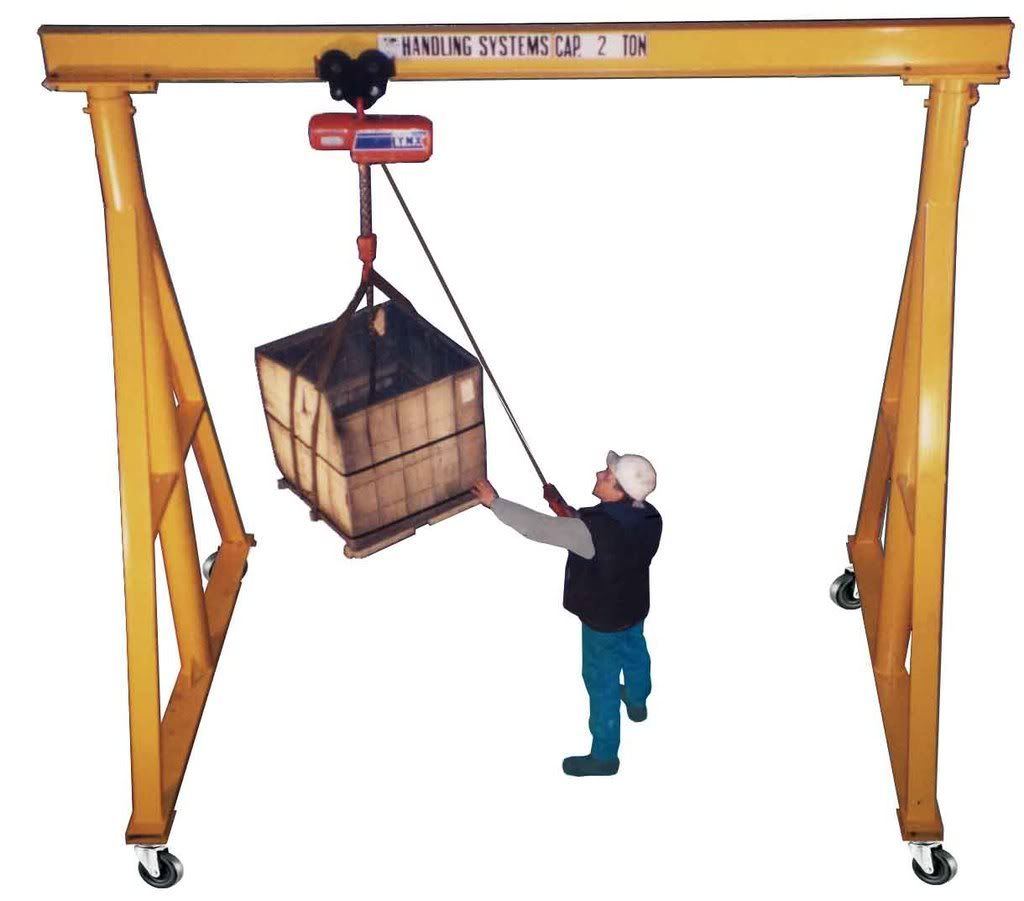
Overhead travelling cranes and gantry cranes are particularly suited to lifting very heavy objects and huge gantry cranes have been used for shipbuilding where the crane straddles the ship allowing massive objects like ships' engines to be lifted and moved over the ship.
Scissors lift

Cranes and Hoist are generally used for moving and raising material
Jib Crane:

A Jib crane is a type of crane where a horizontal member supporting a moveable hoist, is fixed to a wall or to a floor-mounted pillar. They are mainly used on military vehicle and in industrial premises
Wire Rope Hoist:

Chain Hoist

A hoist is a device used for lifting or lowering a load by means of a drum or lift-wheel around which rope or chain wraps. It may be manually operated, electrically or pneumatically driven and may use chain, fiber or wire rope as its lifting medium. Above are examples of a chain hoist and a Wire Rope Hoist.
Overhead Traveling cranes

Gantry cranes

Overhead travelling cranes and gantry cranes are particularly suited to lifting very heavy objects and huge gantry cranes have been used for shipbuilding where the crane straddles the ship allowing massive objects like ships' engines to be lifted and moved over the ship.
Scissors lift

Tuesday, January 8, 2008
Conveyors
A conveyor system is a material handling equipment that moves material from one location to another and are used in a wide variety of business. They are efficient in transporting materials of all sizes, shapes and weights thus reducing the need for labor.
A short video on conveyors
Conveyor Systems are used for
- Moving materials between specified point

- Holding material
- Sortation
- Process purpose

Conveyors can be classified in many different ways
- Type of product being handled (Bulk or Unit)
- Location of the conveyor (Overhead, on-floor or in-floor)
- Whether or not the load can be accumulated
But they are most commonly classified into 3 types which are roller conveyors, belt conveyors and chain conveyors. They can either be powered by a machine or uses the force of gravity. They can be located overhead, on-floor or in-floor depending on the type of material to be transported and the amount of space available.
Here are the common types of conveyor systems used in industries:
Gravity Conveyor System
Gravity systems do not require power supplies, motors and switchgears and are simple in concept. It uses the force of gravity to move the goods. They are used for simple transporting such as conveying cardboard boxes between 2 points.
Advantages: Reliable, Durable and Inexpensive.
Chute Conveyors
 The chute conveyor is often used to link two handling devices and to provide accumulation in shipping. A spiral chute can be used to transport items between floors and it takes up little space.
Advantages: Inexpensive
Disadvantages: Difficult to control the position of goods; packages may shift and cause jams and blockages.
Gravity Roller Conveyors
Able to transport a wide variety of goods thus making it the most commonly used type of conveyor.
- Can move loads of up to 5,000 pounds
- Wide range of straight and curved section available
- Curves are available in straight and tapered roller styles

Advantages: Low unit cost, easy to maintain and simple.
Skate Wheel Conveyors

Skate wheel conveyors consist of discs fitted on to spindles, which are mounted between side channels and the conveyed loads travel along the discs. They are suitable to glide lightweight cartons from one point to another. It is ideal if you must set up up a temporary conveyor line. For use in shipping, warehousing and other assembly areas.
Advantages: Track better then roller conveyors and are faster.
Chain Conveyor

Chain conveyors consist of one or more endless chains on which loads are carried directly and are for heavy loads. They are used as transfer conveyors between roller conveyor systems. They are usually used to transport tote boxes and pallets.
Advantages: Can transport heavy loads
Slat Conveyor

Slat conveyor consists of discretely spaced slats connected to a chain. They are engineered to withstand high temperatures and high impact loading of heavy materials.
Advantages: Able to withstand high temperatures and heavy loads
Flat Belt Conveyor

It consist of continous belting carried on rollers, and are mainly used for light and medium weight load between operations, department, levels and buildings. The friction between the belt and the load, the belt conveyor provides considerable control over the orientation and placement of the load however friction prevents smooth accumulation, merging and sorting of the belt.
Advantages: Good control over position of goods
Magnetic Belt Conveyors
 It consist of a steel belt and either a magnetic slider bed or a magnetic pulley. It is able to transport ferrous materials, horizontally, on inclines or vertically. It is ideal for seperating ferrous from non-ferrous material or parts.
Advantages: Able to transport ferrous materials
Wednesday, January 2, 2008
DCM
Non lifted trucks
Trolleys are used to carry goods around and keep them for safely purposes.
Below are some examples of trolleys that can be found in a warehouse.


Tray Trolley _________Order picking trolley
Pallet trucks are non-stacking pallet lift trucks with openings that allow pick-up by a fork truck
Pallet trucks are used to lift loads and horizontally move objects. Pallet trucks are outfitted for specific use with pallets in storage, warehouse, and manufacturing settings
It is used to deal with heavy items or large quantities and run on either normal internal combustion engines or on electric motors. In addition, some pallet trucks are not capable of changing the width between the two forks, while other types are.

This is a picture of Pump truck Hand Pallet Trucks

This is Pallet Truck with Scale. There is a large LCD display that shows all measurement results in clearly readable numbers, even in dim lighting. Also, the display can be read from different angles around the scale.
Tugs and tractor

This sit-down tractor can handle the heaviest loads safely. As compared to the hand pallet trucks, it can shift heavy loads and handle much more quanitity.
Lifted trucks
Counter-balanced forklift truck

This is a picture of a counterbalance truck. It does not have any stabilization legs protruding from the front so it is ideal for narrow aisle warehouses and placing pallets side by side. The advantages are that it is less expensive, takes up less space and can maneuver in tight aisles. In addition, counterbalancing basically prevents the lift from toppling over by using a series of weights, which is a heavy iron mass or the large lead-acid battery, necessary to compensate for the load.
Some lift trucks are designed for the lifting of pallets exclusively, while other lift trucks are designed to maneuver down narrow aisles. Some examples of a more specialized truck are Articulated Counterbalance Trucks and Guided Very Narrow Aisle trucks.
Reach trucks
A reach truck is a small ride on machine, typically used to lower or raise pallets in small isles of warehouses. Reach trucks normally reach up to 8 meters high. Compared to counterbalanced truck, the length is much shorter. Operator may sit or stand on the machine in a front facing or side on position, depending on the type of the truck.
Double deep reach truck
Double-deep reach trucks use an extended reach mechanism which allows you to store pallets two deep in specially designed double-deep rack
Stacker Truck
Pedestrian stacker, a conventional stacker truck for simple duties and Hand Stacker, design for handing materials are some examples of stacker trucks.
Side Loader

A Side Loader forklift is normally used to pick-up and transport long loads or several pallets next to each other. The loads are picked up at 90 degrees to the direction of travel. The four-way side loader forklift enables all wheels to rotate by 90 degrees for travel within narrow aisles.
High rack stacker
Stacker crane

The stacker crane is electronically controlled and can retrieve unit loads in minutes. It can precisely storage units into an organized space without any complications. With accurate tracking it will lower inventory levels without any problems running out of the products.
The fork can be raised or lowered to any of the levels of a storage rack and can be extended into the rack to store and retrieve product. Stacker cranes are often used in the large freezer warehouses of frozen food manufacturers
Subscribe to:
Posts (Atom)
